Olympic Artist Series, Issue #2: Dorothy Hamill
This Winter Olympic season, Ice Theatre of New York will introduce the art of dancing on ice to hundreds of young skaters, and thousands of new audience members. We cannot do this without your support. Please consider contributing to our community outreach initiatives!

And now, on to our second edition of our Olympic Artist Series...
✍ A message from our Founder & Artistic Director, Moira North: |
Welcome to Day 2 of the Milano Cortina 2026 Winter Olympic Games, and Day 2 of our editorial project featuring Olympic artists in our Ice Theatre of New York family.
Aside from world-class Olympians, these artists have served as performance partners, honorees, and advocates for Ice Theatre of New York. Looking back at all these beautiful partnerships, I am overwhelmed with gratitude to have worked with skaters who perform at the highest level of both sport and artistry.
Today, I am thrilled that we are featuring the dazzling Dorothy Hamill, our 2010 Ice Theatre of New York honoree.
Best wishes to all the 2026 Winter Olympic Competitors!
-Moi
Dorothy Hamill and The Sound of Skating |
This story has been adapted from our 2025 Ice Theatre of New York Gala Program by Edward Z. Epstein - The Audio version of Edward Z. Epstein’s current book, “FRANK & MARILYN: The Lives, The Loves, and The Fascinating Relationship of Frank Sinatra and Marilyn Monroe,” is now available on Audible.
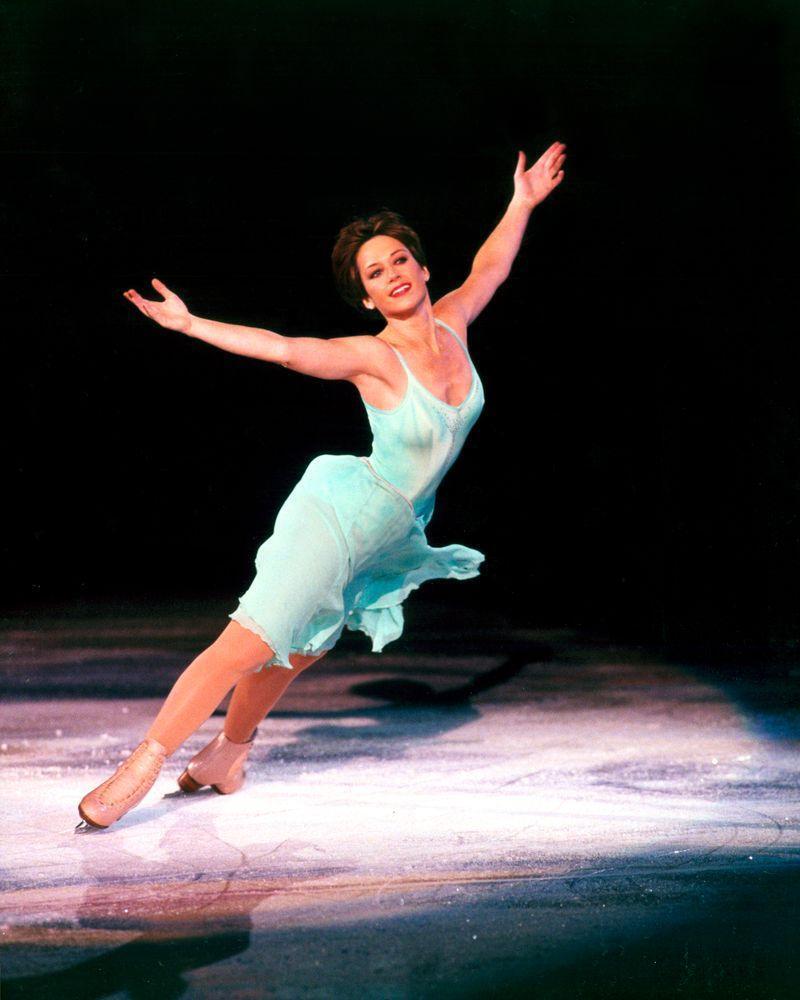
It was a cool fall day, but wearing red, she was a distinctly hot presence on the ice.
Dorothy was rehearsing for a special performance at Rockefeller Center, and the sound of her skating — the whirr of her edging as she skimmed the ice — placed her in a league of her own. It was figure skating in its purest form, the quintessence of the skater’s art. She kept repeating her flying camel and the sound of those preparatory edges added another dimension to the experience of watching her skate.
“I think she’s a better skater today than when she won the Olympics,” states Dick Button, citing her incredible edging, stroking, and body position.
Dorothy and her audience have always had a symbiotic relationship. When she smiles, her audience smiles back at her — and no one is better at expressing emotion through her skating than Dorothy. Her thorough charm is dazzling and real; there have often been times when there was little to smile about.
Carefree, girl-next-door facade to the contrary, her roles in life have gone far beyond skating. She has always functioned as daughter, sister, wife, and above all, mother; there have been many serious issues to contend with over the years.
Growing up in Connecticut, and skating at Lake Placid, produced many happy memories and lasting friendships. Dorothy’s own assessment of her childhood years: “I was a spoiled brat.”
And Dorothy’s rebellious teenage spirit was to prove an asset for a competitive athlete.
The choice to skate was strictly one-hundred-percent Dorothy’s every step of the way. “I wanted to do it every day, all day.” It was never a case of her parents living vicariously through their daughter’s achievements. Dorothy’s good fortune was that her parents recognized, from the outset, that her dream of success on the ice was an achievable goal.
Radiant, blonde Janet Lynn was her role model, but Hamill’s own style emerged in time. She eventually developed a signature spin, a version of the flying camel—the “Hamill Camel”—which added a back sit-spin, preceded by a toe-touch, to the move. Contrary to public perception, Hamill didn’t fall through competitive years injury-free. There were times she skated in excruciating pain, but always soldiered on.
At the age of twelve, in 1969, Dorothy won the Novice Ladies’ title at the U.S. Championships (and made her first appearance with Tom Collins Champions on Ice tour following the World Championships that year). At the 1970 U.S. Championships, competing in the Junior division, she placed second. In 1971, aged fifteen, she entered the Senior division, and from 1974-76 she won the United States Championship.
In 1976, Dorothy was favored by many to win the Olympics, to be held in Innsbruck, Austria. It was a nerve-wracking time. The public was unaware that Dorothy faced a serious crisis of confidence in the weeks preceding the competition. Peter Burrows assumed the role of coach, stepping in for Carlo Fassi. Dorothy’s days were consumed by practice figures and skating her short and long programs straight through, stopping only briefly. If she fell, she had to get up quickly and continue on, “because this could very well happen in competition.”
She was a perfectionist; so was Burrows. They were a formidable team.
As Olympics fever built, so did interest in Dorothy. She was totally surprised when she made the cover of Time magazine. Noted Bergdorf Goodman hairstylist, Suga, gave Hamill a haircut and the “wedge-cut” quickly became a fashion statement, copied by young women all over the world. Dorothy was unaware of the off-ice commotion she was causing; she was laser focused on the upcoming competition: “I had turned out the rest of the world.”
She had connected with the philosopher in Norman Vincent Peale’s The Power of Positive Thinking, given to her by her friend Julie Lynn Holmes. She read and re-read it, frequently.
Even though she came down with the flu, her practice sessions continued.
When she placed second in figures, it was an unwelcome development—the Hamill team worried that it was a prelude to another Silver.
Then she skated a sensational short program — earning a perfect 6.0 from one judge — and moved into first place. This intensified the pressure. Dorothy knew that remaining in first was hardly a sure thing.
If not for her parents, the final result might have turned out differently. It was crucial to take Dorothy’s mind off the imminent ordeal of the long program. A free day enabled Mom and Dad, over the objections of officials, to drive Dorothy to Salzburg and the actual sites where The Sound of Music had actually been lived by the Trapp family. It was the kind of inspiration Dorothy required at that moment: “My Mom knew just what to do.”
The key to skating a successful long program? Don’t overthink the key elements. And even Dorothy had to contend with tired legs that would begin to burn, and feeling winded.
There was a moment during the program — skated to Erich Wolfgang Korngold’s thrilling music, selected by her father, from two of Errol Flynn’s films — when Dorothy almost lost her balance, “but it went unnoticed.” It was a gorgeous performance, even by today’s standards, because of her flawless technique. She owned the ice, performing with great speed and vitality. That “extra spark” was present, and as with all great performances, it appeared effortless.
All nine judges placed Dorothy first, and she got the Gold.
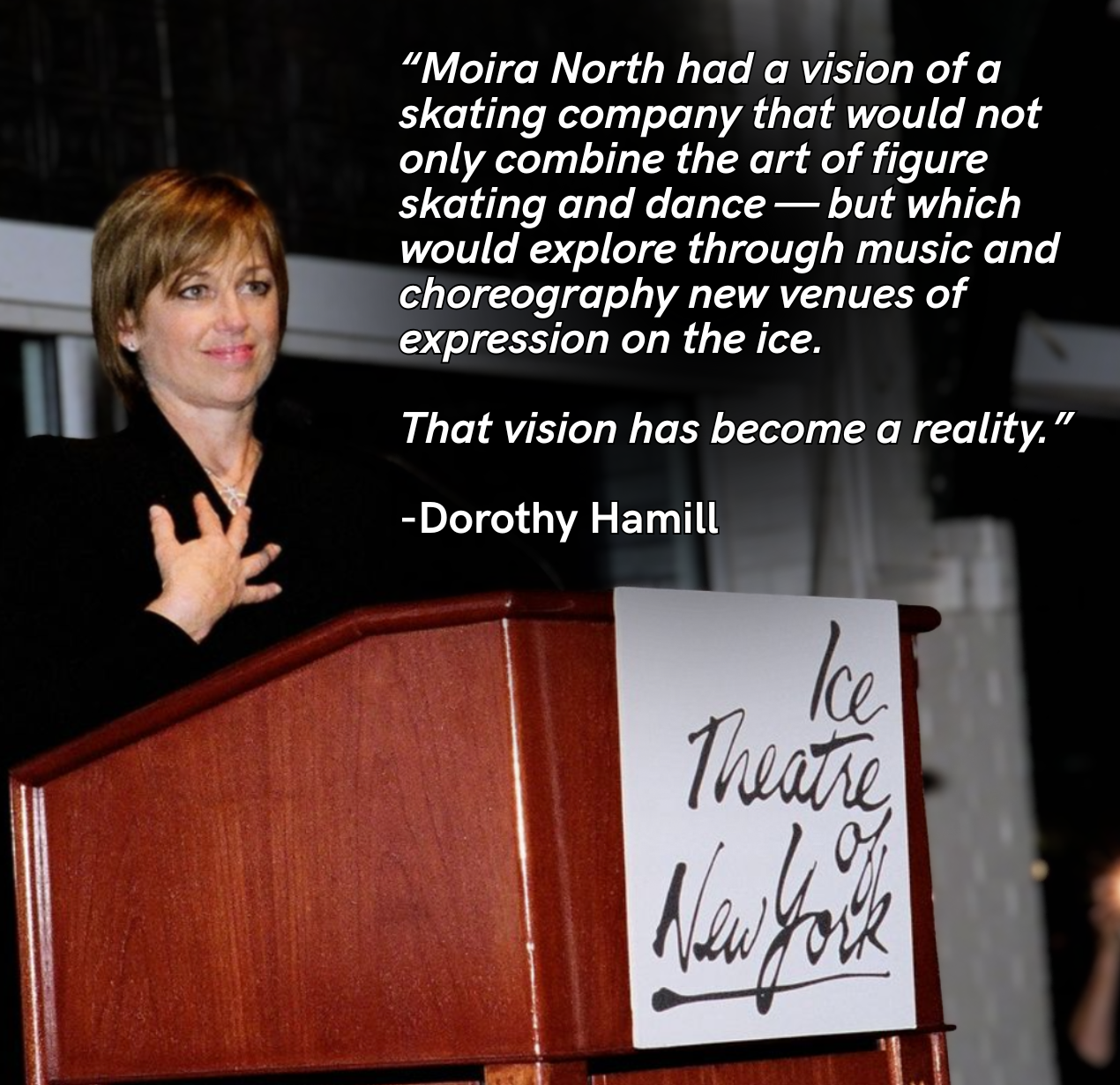
Dorothy Hamill is a longtime advocate of Ice Theatre. At our 25th Anniversary celebration, she said “When she founded Ice Theatre of New York, Moira North had a vision of a skating company that would not only combine the art of figure skating and dance — but which would explore through music and choreography new venues of expression on the ice. That vision has become a reality.”
Thank you, Dorothy, for all you continue to do for our sport, our art, and our community!

This program is supported, in part, by the New York State Council on the Arts with the support of Governor Kathy C. Hochul and the New York State Legislature. ITNY is also supported by the New York City Department of Cultural Affairs, in partnership with the City Council, and NYC Council Members Abreu, Bottcher, Powers and Marte. ITNY's Manhattan programming is funded in part by a grant from the New York City Tourism Foundation.
Additionally, ITNY receives funding from Bloomberg Philanthropies, The Daniel & Corrine Cichy Memorial Foundation,The Lisa McGraw Figure Skating Foundation, the Will Sears Foundation, and its generous private patrons.
Photo credit Judith Angel and ITNY archives