Olympic Artist Series, Issue #17: Sarah Hughes
This is the final issue of our Olympic Artist Series! If you've enjoyed this content, please consider making a donation to Ice Theatre of New York.
The creation of our art relies on the generosity of passionate supporters like you!

And now, on to the final edition of our Olympic Artist Series...
✍ A message from our Founder & Artistic Director, Moira North: |
Welcome to the final day of the Milano Cortina 2026 Winter Olympic Games, and the final day of our editorial project featuring Olympic artists in our Ice Theatre of New York family.
Thank you for coming on this journey with us!
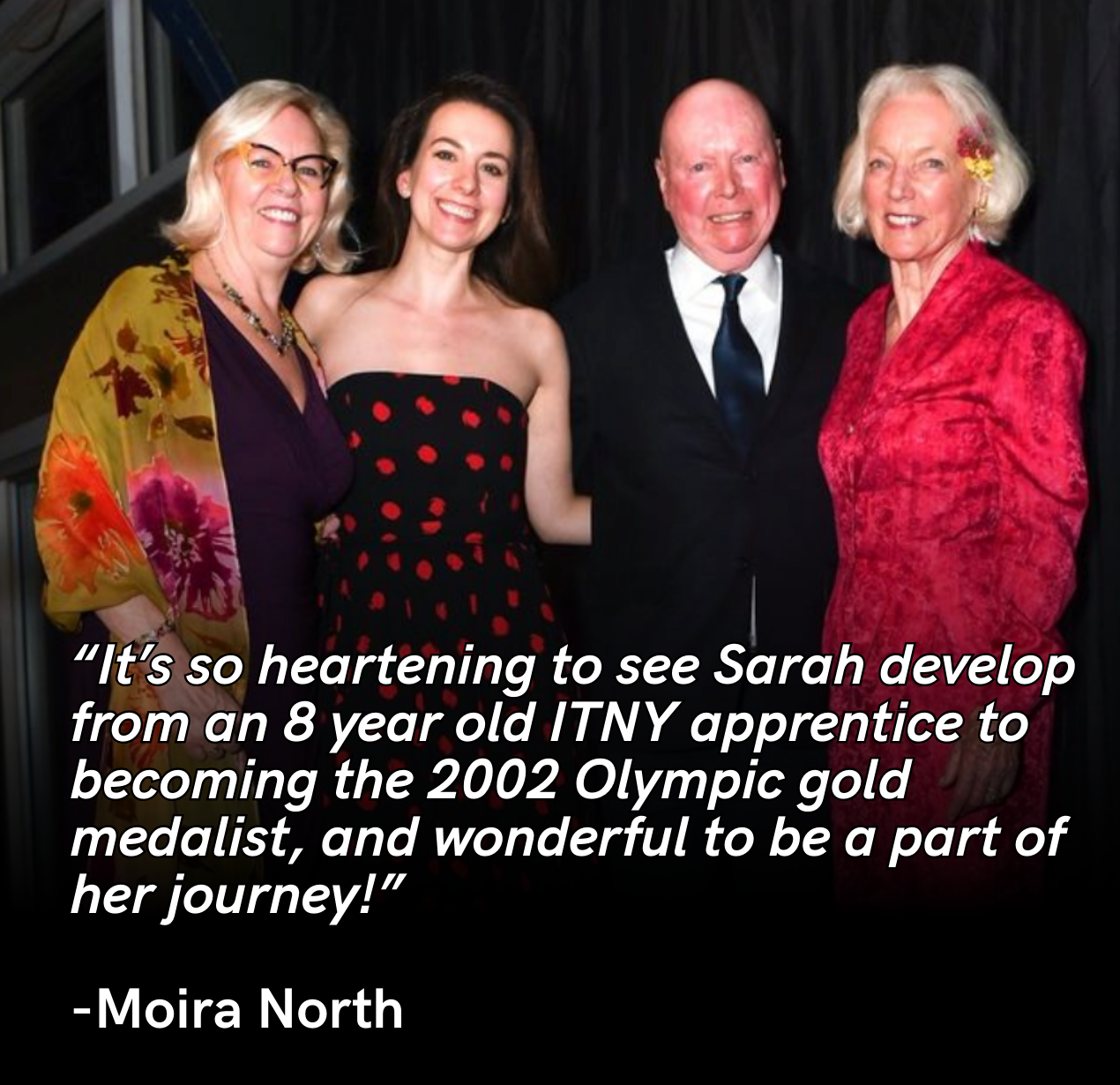
Today, I am thrilled that we are featuring our dear friend Sarah Hughes, who, with her family, was honored by Ice Theatre of New York as an Ice Angel in 2019, and was an ITNY apprentice starting at 8 years old.
Congratulations to all the 2026 Winter Olympic Competitors!
-Moi
Sarah Hughes: Ice Theatre of New York's Golden Girl |
This story has been adapted from our 2019 Ice Theatre of New York Gala Program by Rebecca Hughes Parker.
“Do you all skate?” It is a question the Hughes family has fielded for decades. The answer, as eldest sister Rebecca once put it, is simple: “we do.”
For Sarah Hughes, the fourth of six children raised in Great Neck, New York, skating was never a solitary pursuit. It was a family language. Her father, John Hughes, had grown up playing hockey in suburban Toronto and captained Cornell University’s undefeated 29–0 NCAA championship team in 1970. Her mother, Amy, ferried children and gear from rink to rink, even while undergoing treatment for stage 3 breast cancer in the late 1990s.
In 1983, John first put his kindergarten-age daughter on the ice in group lessons at the local rink. Sarah, born May 2, 1985, would grow up at that rink, sharing sessions with siblings who rotated between figure skating and hockey. Skating was stitched into the calendar. At least one Hughes had been on the ice in Great Neck every season since those early days.
Sarah’s ascent through the national ranks was steady. In 1998, she won the U.S. Junior Championships, a triumph that came just before her mother was hospitalized for a month-long bone marrow transplant. The following year, she captured silver at the World Junior Championships. By 2001, she had earned the bronze medal at the U.S. Championships and was named to the World team.
Then came Salt Lake City.
At the 2002 U.S. Championships, Sarah finished second to Michelle Kwan, securing a place on the Olympic team. Entering the Winter Games in Utah as a 16-year-old, she was considered a contender but not the favorite. After placing fourth in the short program, she delivered a technically ambitious and clean free skate that included two triple–triple combinations. Her total score vaulted her to first place, ahead of Russia’s Irina Slutskaya and Kwan. On February 21, 2002, Sarah Hughes became the Olympic champion.
She remains one of the youngest Olympic gold medalists in ladies’ figure skating history.
The victory altered her life overnight. There were parades, talk show appearances, and the kind of public attention that rarely attaches to a high school junior. Yet the Hughes household had long prized balance. Sarah completed her senior year at Great Neck North High School before enrolling at Yale University in the fall of 2003.
Like her younger sister Emily would later do at Harvard, Sarah pursued academics alongside skating. She continued to compete during her freshman year at Yale, winning the bronze medal at the 2003 U.S. Championships. She retired from eligible competition in 2003 and graduated from Yale in 2009 with a degree in American studies.
Through it all, Ice Theatre of New York remained part of the family’s orbit. Sarah first performed with the organization in 1993 in Annapolis, Maryland. She was eight years old, skating two numbers in six shows. By the fourth performance, her brothers David and Matt had joined in — hockey skates retrieved from the trunk.
Over the years, Sarah returned to ITNY stages for galas, outreach events, and holiday performances. Ice Theatre’s emphasis on artistry resonated with her family’s belief that skating extends beyond medals and point totals. They firmly believed that skating holistically brings the joy of the sport to audiences who might not otherwise encounter it.
That philosophy mirrored Sarah’s own evolution. After the Olympics, she skated professionally in tours and exhibitions, embracing performance as much as competition. She later attended law school at the University of Pennsylvania, earning her J.D. in 2016. Her path — Olympic champion, Ivy League graduate, attorney — reflects the Hughes family’s long-standing refusal to treat sport and intellect as mutually exclusive.
The Hughes siblings cheered for one another from local competitions to Olympic arenas. Rebecca recalls the girls competing “from small ones in Great Neck to the Olympics in Salt Lake City and Torino.” For Sarah, the memory of Salt Lake is inseparable from that larger family tableau: brothers in the stands, parents who had memorized the directions to every rink within an hour of home, sisters who would later chase their own Olympic dreams.
Her mother’s illness during Sarah’s formative competitive years left an imprint as well. Amy Hughes went on to speak across the country on behalf of cancer research and survivor support. Skating had provided a platform. It also provided resilience.
In the years since her Olympic triumph, Sarah Hughes has remained a presence in the skating world and in the charitable efforts that shaped her childhood. Ice Theatre of New York, which has intertwined with the Hughes family for more than a quarter century, continues to feature their participation in various roles — skaters, supporters, even backstage helpers.
So, do they all skate?
Yes.
But in Sarah Hughes’s case, skating became something larger than a gold medal moment in Utah. It was a family inheritance, a proving ground for discipline, and a bridge to the rest of her life — on campus, in courtrooms, and on stages where the red lipstick of Ice Theatre of New York still waits backstage before the lights come up.
Thank you Sarah, for all you've done for our sport, our art, and our community!

This program is supported, in part, by the New York State Council on the Arts with the support of Governor Kathy C. Hochul and the New York State Legislature. ITNY is also supported by the New York City Department of Cultural Affairs, in partnership with the City Council, and NYC Council Members Abreu, Bottcher, Powers and Marte. ITNY's Manhattan programming is funded in part by a grant from the New York City Tourism Foundation.
Additionally, ITNY receives funding from Bloomberg Philanthropies, The Daniel & Corrine Cichy Memorial Foundation,The Lisa McGraw Figure Skating Foundation, the Will Sears Foundation, and its generous private patrons.
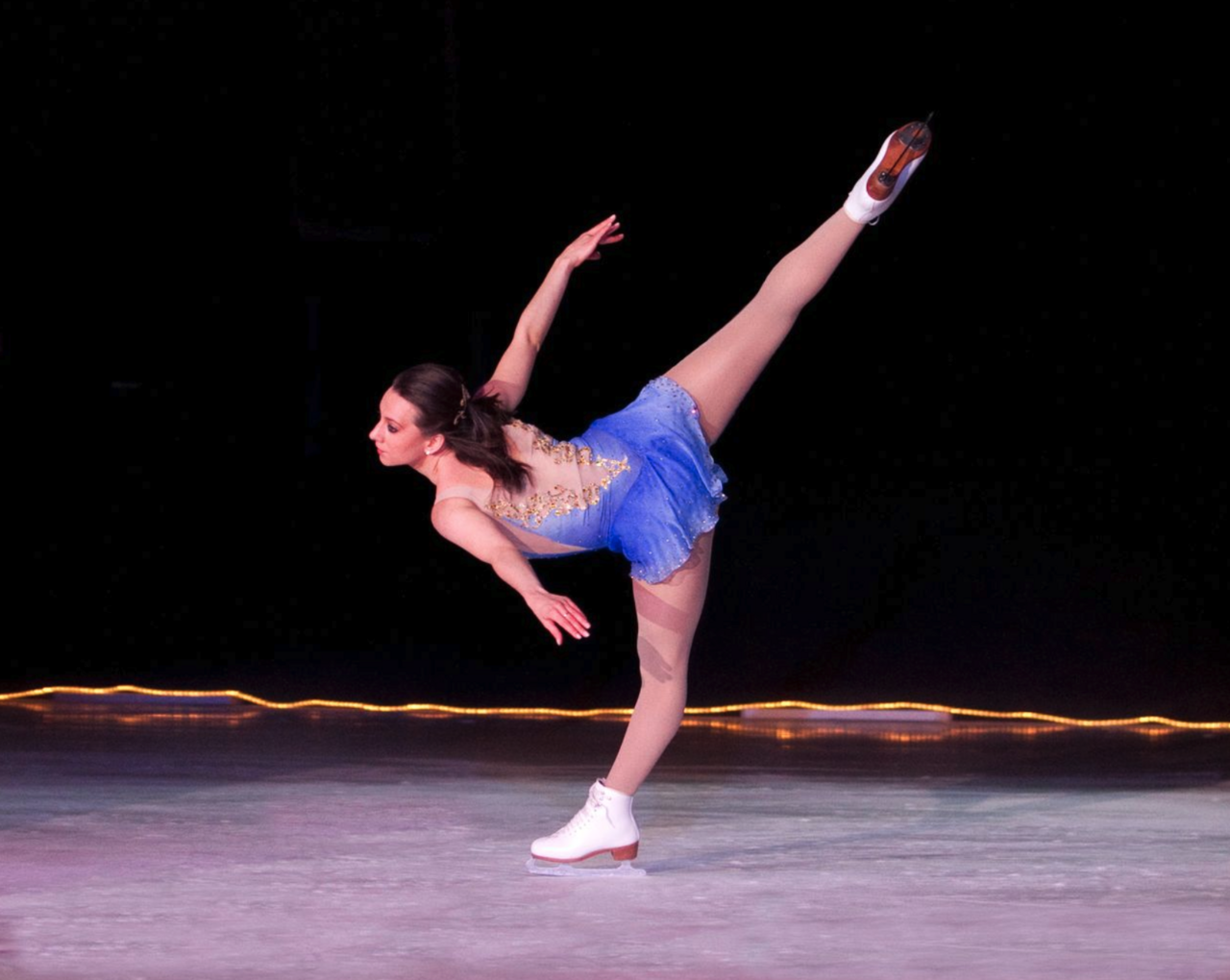
Photo credit Debbie Hickey, ITNY Archives