Olympic Artist Series, Issue #14: Adam Rippon
We're down to our final few issues! If you've enjoyed this content, please consider making a donation to Ice Theatre of New York. The creation of our art relies on the generosity of passionate supporters like you!

And now, on to the fourteenth edition of our Olympic Artist Series...
✍ A message from our Founder & Artistic Director, Moira North: |
Welcome to Day 14 of the Milano Cortina 2026 Winter Olympic Games, and Day 14 of our editorial project featuring Olympic artists in our Ice Theatre of New York family.
Aside from world-class Olympians, these artists have served as performance partners, honorees, and advocates for Ice Theatre of New York. Looking back at all these beautiful partnerships, I am overwhelmed with gratitude to have worked with skaters who perform at the highest level of both sport and artistry.
Today, I am thrilled that we are featuring the beautifully truthful Adam Rippon, Ice Theatre of New York's 2017 Will Sears Award honoree.
Best wishes to all the 2026 Winter Olympic Competitors!
-Moi
The Beautifully Truthful Adam Rippon |
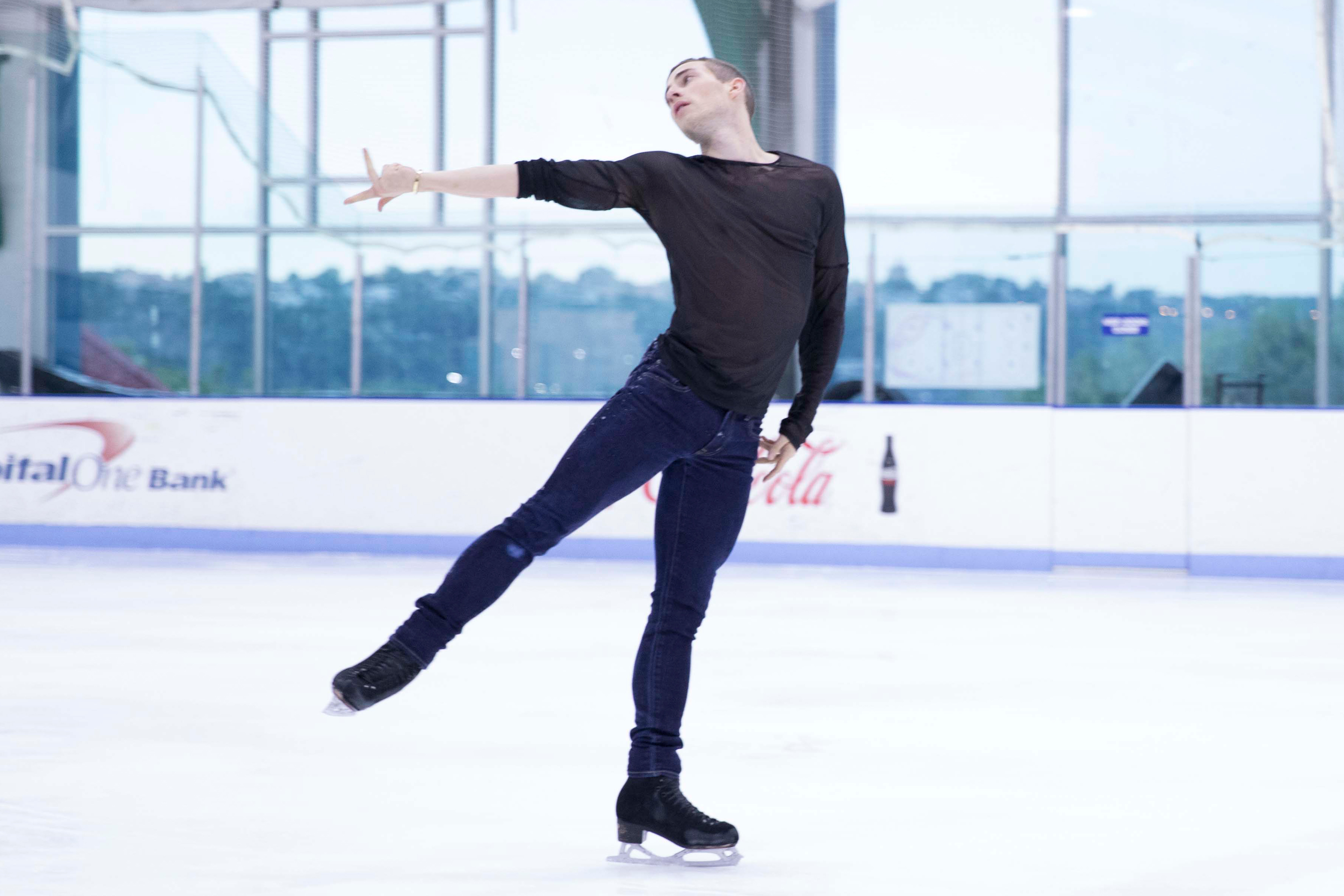
Photo Crystal Kim
"Adam shows people that if you put blood, sweat and tears into what you're doing, you can achieve something that's special," wrote Cher when introducing Adam Rippon for Time Magazine's 100 Most Influential People of 2018. The pop icon recognized something America had already fallen in love with: an athlete who refused to compartmentalize his identity from his artistry.
Adam Rippon arrived into the world on November 11, 1989, in Scranton, Pennsylvania, facing immediate medical challenges. Born with an eye infection and 80 percent hearing loss, both conditions were corrected before his first birthday.
The eldest of six children, he grew up in a household where figure skating had never been a consideration. His mother Kelly worked multiple jobs while raising the family, particularly after his parents divorced in 2004. She combined work as a life coach with hypnotherapy to make ends meet.
At age ten, Adam tagged along when his mother went to skate recreationally. The ice became magnetic. Between 2000 and 2007, he trained under coach Elena Sergeeva in Philadelphia, eventually living with her to eliminate the daily commute. The arrangement saved both time and money, though the family's financial situation remained precarious. Support from the Michael Weiss Foundation in 2006 provided critical relief when costs threatened to derail his training entirely.
His competitive ascent happened with startling speed. In 2008, he became the first man to break 200 points at a Junior level competition, then won gold at the Junior World Championships. The following year, he made history again, becoming the first single skater to win two World Junior titles. Olympic glory seemed inevitable.
Except it never came.
Adam missed the 2010 Olympic team. Four years later, he finished eighth at the 2014 U.S. Nationals after falling five times during his free skate. Then came a coaching carousel: Nikoli Morozov, Brian Orser, Jason Dungjen, finally Rafael Arutunian in 2012. Each change brought new systems, new expectations, new adjustments.
Finally, something shifted. On October 2, 2015, Adam publicly came out as gay in Skating Magazine. The announcement rippled through his entire approach to the sport. After coming out, his skating transformed. He began writing his own practice plans, hired a new fitness trainer, revamped his entire style. The weight of pretending had been enormous. Released from it, he discovered a different kind of athlete living inside.
In 2016, Adam won his first U.S. National Championship at age twenty-six, performing to a Beatles medley that prioritized elegance over the quadruple jumps overtaking men's skating.
His calling card became the "Rippon Lutz" — a triple Lutz executed with both arms raised above his head. Adam explained: "It was a time where a lot of quads weren't being done so a lot of men were doing the same triples. I wanted to do something that would set me apart."
Weeks before the 2017 Nationals, Adam broke his foot and had to withdraw. The injury could have ended his Olympic dreams permanently. Instead, he used the recovery period to reimagine himself once more.
When he made the 2018 PyeongChang Olympic team at age twenty-eight, Adam became the oldest first-time American Olympic figure skater in more than eighty years. His Olympic experience transcended athletics almost immediately. He helped Team USA win bronze in the team event, making him the first openly gay American man to win a Winter Olympic medal.
Then he went further.
Within months, he won season 26 of Dancing with the Stars with partner Jenna Johnson. He became a correspondent for Good Morning America, guest-hosted RuPaul's Drag Race, and appeared in Taylor Swift's You Need to Calm Down music video. His memoir Beautiful on the Outside arrived in 2019 to glowing reviews. At the 2019 Time 100 Gala, Adam honored his mother, crediting her dedication and inspiration for his success.
His post-Olympic ventures have continued: starring in MTV's Messyness, winning Fox's Stars on Mars in 2023, joining NBC as a figure skating analyst alongside Ashley Wagner for the 2024 U.S. Championships. Throughout it all, he has maintained a consistent presence advocating for LGBTQ+ youth.
Adam Rippon's career resists easy narratives about natural talent or preordained success. What elevated him beyond athletics was the decision to stop hiding. “His passion and charm have made him an inspiration to young and old alike, making him a role model and icon to millions,” said Moira North, Ice Theatre of New York’s founder.
By choosing honesty over palatability, he discovered that the most powerful performance happens when you stop performing altogether.
Thank you Adam, for all you've done for our sport, our art, and our community!

This program is supported, in part, by the New York State Council on the Arts with the support of Governor Kathy C. Hochul and the New York State Legislature. ITNY is also supported by the New York City Department of Cultural Affairs, in partnership with the City Council, and NYC Council Members Abreu, Bottcher, Powers and Marte. ITNY's Manhattan programming is funded in part by a grant from the New York City Tourism Foundation.
Additionally, ITNY receives funding from Bloomberg Philanthropies, The Daniel & Corrine Cichy Memorial Foundation,The Lisa McGraw Figure Skating Foundation, the Will Sears Foundation, and its generous private patrons.
Photo credit ITNY Archives, Crystal Kim