Olympic Artist Series, Issue #13: The Protopopovs
If you enjoy this content, please consider making a donation to Ice Theatre of New York. The creation of our art relies on the generosity of passionate supporters like you!

And now, on to the thirteenth edition of our Olympic Artist Series...
✍ A message from our Founder & Artistic Director, Moira North: |
Welcome to Day 13 of the Milano Cortina 2026 Winter Olympic Games, and Day 13 of our editorial project featuring Olympic artists in our Ice Theatre of New York family.
Aside from world-class Olympians, these artists have served as performance partners, honorees, and advocates for Ice Theatre of New York. Looking back at all these beautiful partnerships, I am overwhelmed with gratitude to have worked with skaters who perform at the highest level of both sport and artistry.
Today, I am thrilled that we are featuring the poetically inventive Protopopovs, dear late friends of Ice Theatre of New York.
Best wishes to all the 2026 Winter Olympic Competitors!
-Moi
The Protopopovs: Power & Poetry |
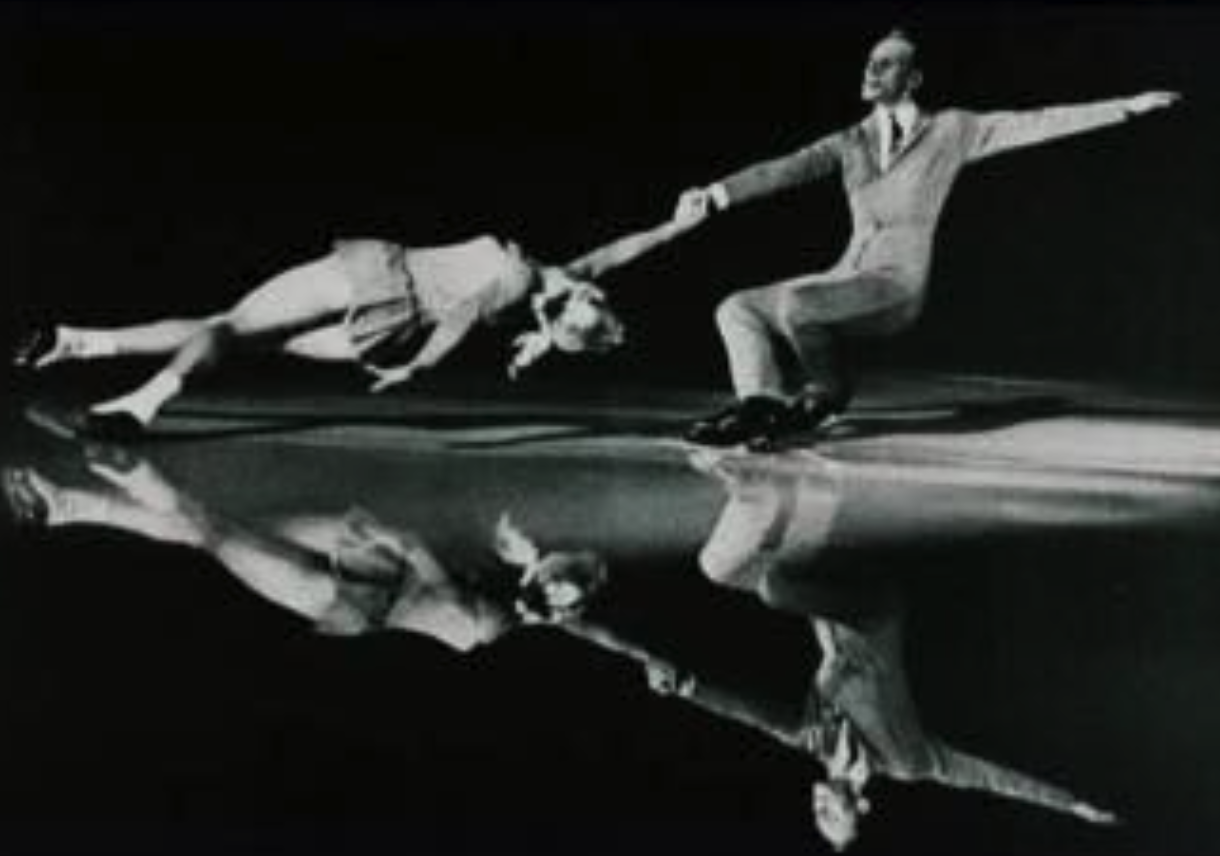
Oleg Protopopov was 15 when he began skating. Ludmila Belousova was 16.
Neither was a child prodigy. Neither was groomed from infancy for Olympic glory. They met at a skating seminar in Moscow in 1954, began training together in 1956, and married in 1957. Though Ludmila kept her birth surname, the skating world came to know them simply as “The Protopopovs”.
What began as a partnership in the Soviet Union would become a reinvention of pairs skating itself.
Oleg Alekseyevich Protopopov was born in 1932 in Leningrad, now St. Petersburg. His mother was a ballerina; his stepfather, a poet. During the Nazi siege of Leningrad, he survived by eating blocks of wood glue. Those early years shaped both his resilience and his artistic sensibility. Ballet and literature would later inform the slow, lyrical, almost devotional quality of the skating he created with Ludmila.
By 1960, the couple had reached the Winter Olympics in Squaw Valley, California, finishing ninth. They were not yet medal contenders. But they were building something different — something that did not rely solely on strength or speed.
Four years later, in Innsbruck in 1964, they became the first skaters from Russia — or the Soviet Union at large — to win Olympic gold in pairs. They repeated the feat in 1968 in Grenoble. Ludmila was 32; Oleg was 35 — among the oldest pairs ever to win Olympic gold.
In between, they captured every World and European title from 1965 through 1968.
But medals tell only part of the story.
The Protopopovs created their own choreography. They introduced three variations of the death spiral. They approached lifts and pair elements not as acrobatics but as extensions of musical phrasing. They skated with unison, fluidity, and emotional continuity. Dick Button once said of them, “They belong at the peak of the pinnacle of pairs skating.”
Others called them romantic, creative, bewitching, elegant and graceful.
Their influence extended beyond their own competitive years. From 1964 to 2006, Soviet or Russian skaters would win 12 consecutive Olympic gold medals in pairs. The standard they set became the cultural and technical foundation of a dynasty.
But the sport was changing.
Pairs skating was becoming faster, more muscular, more acrobatic. By 1969, Soviet officials, convinced that the Protopopovs could not or would not adapt to the new athletic direction, effectively retired them and reassigned them as coaches.
They resisted that quiet ending.
In 1979, during a skating tour in Switzerland, they defected.
“Our decision to leave was correct and timely,” Oleg later told the Russian newspaper New Izvestia. “There were no politics in our departure. We simply understand that we are strangers in our homeland, that we will not be allowed on ice for as long as we wanted and could. In the U.S.S.R., they could do with us anything they like.”
For years after their defection, they were erased from official Soviet record books. In a 1985 directory titled All About the Soviet Olympians, their names did not appear.
In the West, however, they continued skating.
They signed a $2 million contract to tour with Ice Capades in the United States. They performed for decades — no longer executing the demanding lifts and death spirals of their competitive peak, but preserving the balletic line and lyrical unity that had defined them.
In 1998, in their 60s, they sought to skate for Switzerland at the Winter Olympics in Nagano. Their goal, Oleg told The New York Times, was not to win another gold medal but to connect the sport’s athletic present with its aesthetic past. Officials refused to waive qualification requirements for touring professionals.
By then, modern pairs featured “muscular throws, gymnastic lifts and robust triple jumps,” as The Times noted. Yet much of what remained prized in a classical sense — graceful unison, fluid spins, musical interpretation — began with the Protopopovs.
They never fully embraced the high-speed athleticism that defined later generations.
“For me,” American Olympic silver medalist and Ice Theatre of New York honoree Paul Wylie once said, “this couple invented the classical balletic sport of figure skating. They still epitomize artistry and athleticism like nobody else.”
After the collapse of the Soviet Union, their homeland’s posture softened. In 2003, they accepted an invitation to return to Russia. The public welcomed them as heroes. They attended the 2014 Winter Olympics in Sochi as honored guests, seated in a section reserved for distinguished figures in skating history.
They divided their later years between Switzerland and summers in Lake Placid, New York. Even after Oleg suffered a stroke in 2009 and had a pacemaker implanted, they skated most days.
“We are always inclined to consider that it is better to die on the ice than in a clinic for the aged,” he said in 2014. We lost Ludmila in 2017 at 81, and Oleg followed in 2023 at 91.
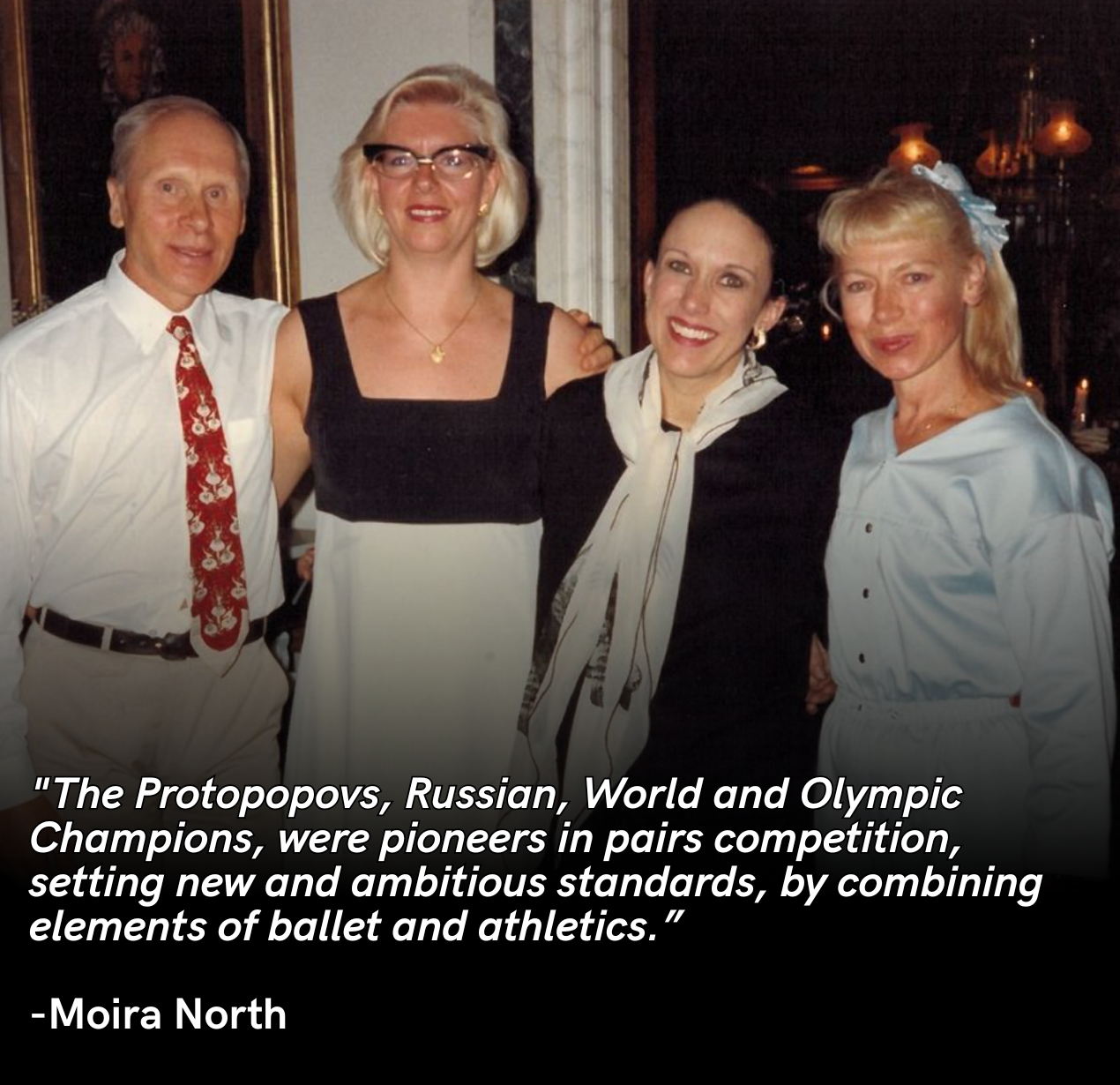
Long before pairs skating became a showcase of explosive power, they demonstrated that it could also be poetry. Moira North notes, "The Protopopovs, Russian, World and Olympic Champions, were pioneers in pairs competition, setting new and ambitious standards, by combining elements of ballet and athletics.”
Thank you, Oleg & Ludmila, for all you've done for our sport, our art, and our community!

This program is supported, in part, by the New York State Council on the Arts with the support of Governor Kathy C. Hochul and the New York State Legislature. ITNY is also supported by the New York City Department of Cultural Affairs, in partnership with the City Council, and NYC Council Members Abreu, Bottcher, Powers and Marte. ITNY's Manhattan programming is funded in part by a grant from the New York City Tourism Foundation.
Additionally, ITNY receives funding from Bloomberg Philanthropies, The Daniel & Corrine Cichy Memorial Foundation,The Lisa McGraw Figure Skating Foundation, the Will Sears Foundation, and its generous private patrons.
Photo credit ITNY Archives