Olympic Artist Series, Issue #15: Barbara Ann Scott
We're down to our final few issues! If you've enjoyed this content, please consider making a donation to Ice Theatre of New York. The creation of our art relies on the generosity of passionate supporters like you!

And now, on to the fifteenth edition of our Olympic Artist Series...
✍ A message from our Founder & Artistic Director, Moira North: |
Welcome to Day 15 of the Milano Cortina 2026 Winter Olympic Games, and Day 15 of our editorial project featuring Olympic artists in our Ice Theatre of New York family.
Aside from world-class Olympians, these artists have served as performance partners, honorees, and advocates for Ice Theatre of New York. Looking back at all these beautiful partnerships, I am overwhelmed with gratitude to have worked with skaters who perform at the highest level of both sport and artistry.
Today, I am thrilled that we are featuring the illustrious Barbara Ann Scott, a dear late friend of Ice Theatre of New York.
Best wishes to all the 2026 Winter Olympic Competitors!
-Moi
Barbara Ann Scott: Canada's Sweetheart |
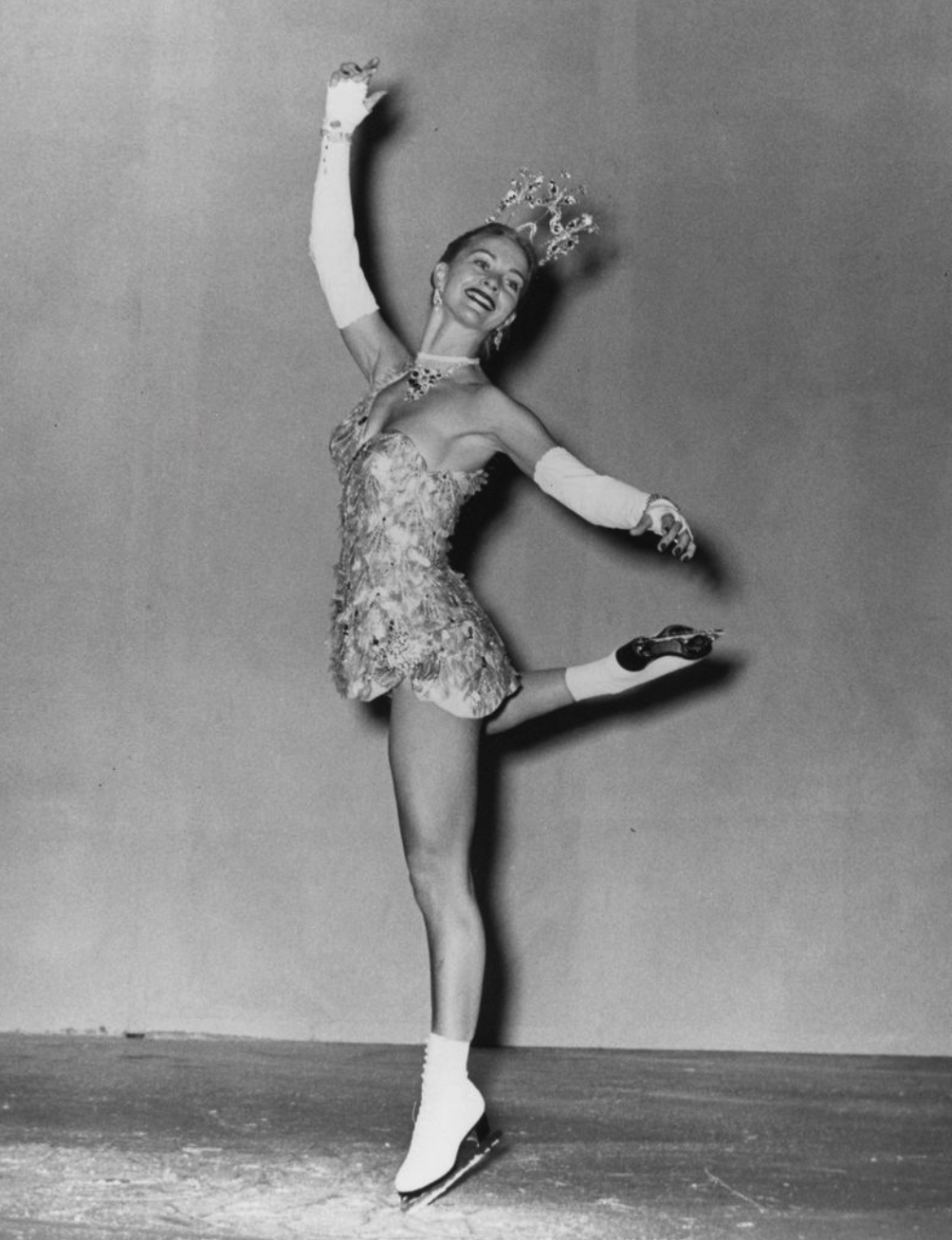
Barbara Ann Scott's relationship with figure skating began with an image rather than an experience. At age six, she received her first pair of black skates as a Christmas gift, inspired by photographs of Olympic champion Sonja Henie. What started on double runners at Ottawa's Dow's Lake grew into something far greater. Soon she was training seven hours a day at the Minto Skating Club, her childhood rescheduled around ice time and private tutoring.
Skating was never separate from discipline. Scott's father, Clyde, a disabled veteran of World War I who worked in the Division of Veterans' Affairs, had considerable impact on his daughter's early life. "The main lessons my father taught me were those of sportsmanship and of self-help," she said. When he died suddenly in 1941, Barbara Ann was just thirteen. The loss left her and her mother Mary not only emotionally bereft but financially strained.
Yet it only strengthened her determination.
Her skating stood out for its technical precision and innovative daring. At age ten she became the youngest skater ever to pass the "gold figures test" and at eleven won her first national junior title. "I loved them," she said of school figures, the meticulous tracings that counted for sixty percent of competition scores.
But it was her free skating that captured attention.
In 1942, at age thirteen, she became the first woman of any nationality to land a double Lutz jump in competition, a groundbreaking achievement that marked her as someone pushing the boundaries of what female skaters could do.
Barbara Ann trained with Otto Gold and later Sheldon Galbraith, and it was Galbraith who put the finishing touches on her performance and set her on the championship path. He changed her music and choreography, preparing her for international competition.
According to figure skating writer and historian Ellyn Kestnbaum, Barbara Ann "brought polish, glamour, and feminine delicateness" to figure skating. She was also one of the first skaters to specifically choreograph and to musically interpret her free skating programs, instead of using music as a background accompaniment.
By 1947, funded by community donations, Barbara Ann traveled overseas and made history.
Within six weeks, she held the concurrent titles of Canada, North America, Europe, and the World. She became the first North American to win the European championship and remains the only Canadian to have won the European title.
St. Moritz, Switzerland hosted the 1948 Games, the last Olympics where figure skating would be held outdoors. Conditions were brutal. Barbara Ann was forced to execute her school figures on watery ice during warm days, with eager press photographers encroaching. She made no errors.
Then came the free skating. The ice surface was so full of holes and ruts from a preceding hockey game that Barbara was forced to mentally revise her program while waiting her turn to perform. Before the competition, she and Galbraith explored every inch of the ice, taking note of any imperfections and strategically placing her jumps in the best spots.
She did one double loop instead of three at the beginning and ended with three double Salchows instead of the double loops originally choreographed. What followed was described as brilliant.
"Beauteous Barbara Ann Scott, Canada's sparkling ballerina on the ice, won the women's figure skating championships before 7,000 dazzled admirers who hailed her performance as superior to Sonja Henie's best as an amateur," the New York Daily News reported. She won Olympic gold.
After the Olympic win she received a telegram from Prime Minister Mackenzie King, stating that she gave "Canadians courage to get through the darkness of the post-war gloom." When she returned to Ottawa, she was greeted by a crowd of 70,000 people in Ottawa's Confederation Square.
Barbara Ann stepped away from amateur skating fame and into professional shows. She went on to replace her childhood idol Sonja Henie in the starring role with the "Hollywood Ice Revue" in Chicago. "I hate living out of a suitcase," she told reporters. "Some time I want to marry and have children, and I believe that should be organized economically, tidily, and exactly, like Olympic skating or anything else."
She retired from skating in 1955 to marry Tommy King, a publicist she met while touring. The couple settled in Chicago, where Barbara Ann pursued a second sporting career: training show horses, and in her mid-40s was rated among the top equestrians in the US.
In recognition of her stature in Canadian Olympic history, Barbara Ann was one of the first two torchbearers to carry the Olympic flame in St. John's, Newfoundland on its relay across the country ahead of Calgary 1988. She also carried the Olympic flame in the House of Commons during the Vancouver 2010 torch relay. In 2011, she donated her Olympic gold medal to the city of Ottawa.
"Canada's Sweetheart" became more than a nickname.
Her picture was perpetually plastered across international newspapers, while an incredible number of little girls born in the late 1940s and early 1950s were named Barbara Ann. There were Barbara Ann dolls, Barbara Ann skates, and Barbara Ann teddy bears.
"The most important thing about skating is that it teaches you to do the things you should do before you do the things you want to do," Barbara Ann once said, a philosophy that defined her approach to life. She remained active in skating as a judge, published books including Skate With Me, and contributed to charitable causes. Her contract as a professional specified that a portion of her salary be donated to aid handicapped children.
She was inducted into the Canadian Olympic Hall of Fame in 1948, Canada's Sports Hall of Fame in 1955, and in 1991 was made an Officer of the Order of Canada. Barbara Ann Scott died on September 30, 2012, at her home in Amelia Island, Florida, at age 84.
As Canada's first and only Olympic ladies' singles gold medalist in figure skating, she remains a symbol of grace, determination, and technical innovation — a skater who transformed what was possible and inspired generations to follow.
Thank you Barbara Ann, for all you've done for our sport, our art, and our community!

This program is supported, in part, by the New York State Council on the Arts with the support of Governor Kathy C. Hochul and the New York State Legislature. ITNY is also supported by the New York City Department of Cultural Affairs, in partnership with the City Council, and NYC Council Members Abreu, Bottcher, Powers and Marte. ITNY's Manhattan programming is funded in part by a grant from the New York City Tourism Foundation.
Additionally, ITNY receives funding from Bloomberg Philanthropies, The Daniel & Corrine Cichy Memorial Foundation,The Lisa McGraw Figure Skating Foundation, the Will Sears Foundation, and its generous private patrons.
Photo credit ITNY Archives