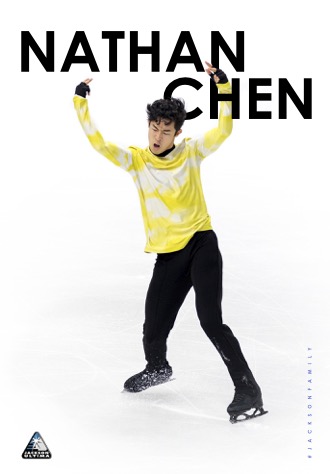
Meet Nathan Chen
Nathan Chen, Olympic and World Champion
Nathan Chen: A Polymath on Ice
By Philip Hersh, for ITNY's 2026 Benefit Gala Journal
In 2017, not long after Nathan Chen had won his first of what would be six straight U.S. titles in figure skating, we talked briefly about his background in ballet.
Now, a lot of figure skaters mention having done ballet, but it is usually little more than something for a sentence in their bios.
But he did not see it the way most skaters do, as just another box to check, like sessions to work on strength, flexibility and endurance.
Chen was serious about the dance lessons, as many as six per week, that he took for 6 ½ years at Ballet West Academy in Salt Lake City. He started the lessons at age seven to help his skating. He kept them up for a less pragmatic reason.
“I love ballet,” he said.
And he was good, too.
Madison Young danced with Chen in Ballet West productions of The Nutcracker, Sleeping Beauty and Swan Lake. She is now a principal dancer of the Vienna State Ballet. This is what she said about Chen back in 2017:
"If he wanted to be a dancer, I have no doubt he would be amazing, a star," Young said.
Figure skating long had taken precedence over his other extracurricular activities, which also included piano, violin, hockey and gymnastics. But Young’s opinion was seconded, even more emphatically, by his ballet teachers.
They saw in the pre-teen Chen an artistic and athletic polymath with a high level of dedication, a maturity that allowed him to concentrate fully on a task and an ability to quickly grasp new concepts. When added to his physical coordination, that seemed to guarantee success in whatever pursuit he chose to focus on.
“Frankly, I think I chose the right one because I have a very flat feet, and I'm quite short, so I think those two things restrict me a little bit from becoming a very impressive ballet dancer,” he said.
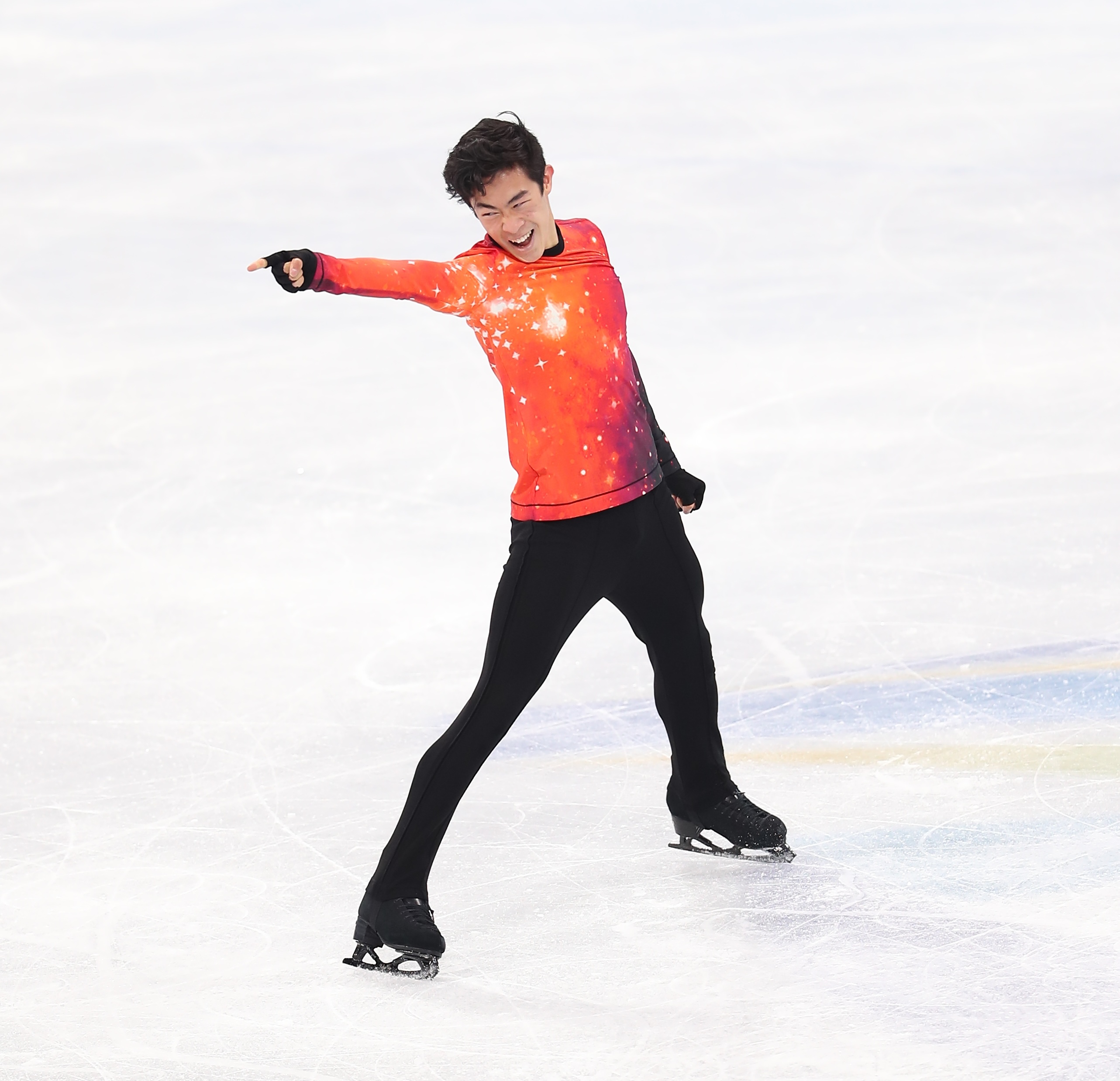
Yet he came to regret how much the need to cram his figure skating programs with point-getting elements left little time to show the details from his ballet training. It still came though on the ice as an overall picture in his signature skating programs, like “Nemesis,” “La Bohème,” “Philip Glass medley,” and ”Rocket Man,” the last used for the free skate to Elton John music that brought him the 2022 Olympic singles gold medal and shout outs from Sir Elton himself.
“There’s a lot of like, `It feels good,’ in ballet,” Chen said. “You get to see yourself move, and see all the people around you move in really, really esthetically pleasing ways.
“It’s like I'm not doing that movement to optimize my dreams or anything to that effect, but more just like, feel myself, feel the energy, feel the flow, and all those kinds of things. And they're kind of intangibles, but they make skating and ballet just so complete and worthwhile and enjoyable.”
The link he embodies between two disciplines that combine artistry and athleticism is underscored by the Ice Theatre of New York’s selection of Chen as its 2026 Honoree.
"As the nation's first dance company on ice, it feels so natural to honor Nathan Chen, both as an Olympian and as a trained ballet dancer,” ITNY founder and artistic director Moira North said. “In this Olympic year, we look forward to celebrating Nathan's many talents and contributions to our `icy’ world."
“What they're doing for the community is fantastic,” Chen said of ITNY. “They provide an opportunity to explore skating in a very different light than what we conventionally see on TV. I think they're impactful and necessary, and I appreciate the work they're doing to have skating really maintain itself as an art form.”
Chen, 26, retired from competition after the 2022 Winter Games, in which he also won a gold medal in the team event. He spent the next two years finishing his undergraduate studies at Yale, winning an outstanding thesis award from the Yale Department of Statistics and Data Science. Thesis title: “Utilizing Deep Learning to Predict Somatic Variant Pathogenicity.”
(Polymath, redux: Chen also wrote an essay for the book, “Studies in Time: Essays on the Music of Philip Glass,” which accompanied a box set issue of the celebrated minimalist composer’s piano etudes. In his 2020-21 season free skate to Glass’ music, Chen clearly showed a physical as well as intellectual understanding of Glass, having studied his music at Yale and having learned how to play part of it on the piano.)
He then moved on to Goucher College in suburban Baltimore, where he enrolled in a one-year program designed to fill in science course gaps for medical school applicants. He awaits news on the fate of his applications.
Chen, inducted into the U.S. Figure Skating Hall of Fame in January, hasn’t spent much time on skates the past two years. Between his studies at Goucher and his daily work as a research assistant in Johns Hopkins’ Malone Center for Engineering in Healthcare, he has found time to get to a rink only about twice a month. He also does some Your True Step skating seminars with his close friend, U.S. Olympic ice dancer Jean-Luc Baker, and dancer/choreographer Sam Chouinard.
With his course work at Goucher finished at the end of 2025, Chen was able to go to the 2026 Winter Games as a contributor to yahoo! sports.
The last show tour Chen did was Stars on Ice in 2023. He most recently performed last fall in the Scott Hamilton & Friends show, which benefits the 1984 Olympic champion’s Scott CARES Foundation for cancer research.
“That was a very brief number,” Chen said. “Most of the stuff I do is like that, for fundraising.
“If I can't feel as though I'm at the sort of level that I would want to present myself at, then I don't really want to do it. In order to get there, I have to make sure that I spend enough time on the ice. Logistics have been challenging in order to maintain that. So that's sort of like a barrier.’’
The Scott Hamilton show was a perfect fit for Chen, given that he will go to medical school already having found that cancer is “of particular interest to me.”
The Hopkins lab where Chen works is headed by computer scientist Dr. Alexis Battle. Her research, according to the school’s web site, “is concentrated on the development of computational biology tools and machine-learning strategies to examine genetic differences on gene regulation and disease.”
Chen, a data science and statistics major at Yale, is using those skills and knowledge in the lab.
"The particular work I do is exploring frailty, the disease of aging, and trying to understand trajectories of the disease, as well as any biological signals,” Chen said.
“The overall subject is combinational biology in nature, but the day to day is very much statistics and data science-focused, (including) data cleaning and running basic statistical models and things.”
Battle, a professor of biomedical engineering, computer science and genetics, sees the qualities that made him an exceptional skater contribute to his work in the lab. She also is impressed by Chen’s contributions outside of science, noting he was “shoveling compost with the best of them” at a lab volunteer day in a community garden.
"Dedication and focus translate from athletics to science and academics,” Battle said in an email. “He is very good at identifying milestones and working toward them. I can see this in his research in the lab and in his pursuit of a medical education. He is methodical, focused, and goal-oriented, and he consistently produces thoughtful analysis for the genomics data we are working with.”
To the question of what she has found most interesting about Chen, Battle wrote, “It has been very interesting to understand the risks that he and his family took to pursue his skating career. They had to make difficult decisions when he was still quite young, and the path they chose required not only athletic skill, but also exceptional maturity and dedication on his part.
“I also find it interesting that Nathan is so dedicated to his community and to young skaters in particular. He knows first-hand the stresses and challenges that young athletes face, and he is motivated to lift them up and help them feel less alone. This is another example of his exceptional maturity.”
In his first two years at Yale, he balanced a full commitment to school with a full commitment to skating. After the Covid pandemic hit in the second semester of his sophomore year, forcing the university to institute remote learning for 18 months, Chen decided to take two academic years off rather than his originally planned one before the 2022 Olympics.
But he had friends send him the textbooks he figured to eventually be using in chemistry and advanced statistics courses for a little light reading.
“Nothing super serious,” Chen told me a couple weeks before the 2021 U.S. Championships. “Just trying to get through a chapter a day.”
He went to the 2022 Olympics in Beijing as the favorite and won the gold medal easily, getting a record score in the short program and then mastering a free skate of surpassing difficulty with five clean quadruple jumps and two inconsequential mistakes.
He even was able to muster a wry smile after one of the errors, as if to underline his pledge to have fun at his second Olympics, to free his head of the anxiety that had overwhelmed him during his Winter Games debut in 2018.
Chen managed to keep that vow despite the claustrophobic atmosphere and empty arenas necessitated to create a protective anti-Covid bubble in Beijing. And he kept it despite having had four long years to carry the mental baggage of what had happened at the 2018 Olympics, when he got swept up in medal expectations and finished fifth after staggering to 17th in the short program.
He won in 2022 despite the weight of expectations that grew exponentially after he won the three world championships between the two Olympics. He did it with a will that drove him to push himself and his sport past seemingly established limits, a will that allowed him to become the seventh U.S. man to win an Olympic singles figure skating gold medal.
And he did it despite obstacles few were aware of until he mentioned them in interviews right after the free skate and later elaborated on them in his biography, “One Jump at a Time,” written with Time Magazine’s Alice Park and published in late 2022.
"I never thought I would actually be able to make this happen,” Chen said. “It was a pretty daunting mountain.”
His coach, Rafael Arutunian, spoke of Chen and his mother, Hetty Wang, driving every few months from Salt Lake City to southern California for lessons with him at the start of their working relationship. They were lessons the family could not really afford, so Arutunian would take the money Chen’s mother paid him and give it back to her son.
“One day he said to his mom, ‘If we don’t move, I will not make it,’” Arutunian said. “This was an 11-year-old boy saying that.”
They soon moved to California so he could work with Arutunian daily.
“My mom and I grew up quite poor, and Raf obviously knew about the situation,” Chen said in Beijing. “He would say, `I don’t really want that money. I want you to achieve the goal you want.’”
I never knew any of that back story until that moment, despite having written about his figure skating career for seven seasons, beginning with the 2016 U.S. Championships.
I saw him only at competitions, when the chances to have insightful conversations are minimal.
Even though Chen was gracious enough to do several one-on-one telephone interviews with me, they were generally brief. Even then, his reticence to share things that only he, his family and his coaching team were familiar with, matters both personal and skating-related, was very obvious.
“I’m pretty introverted, I’m pretty quiet,” Chen told me during a telephone conversation this spring. “In general, I like the shadows.”
He preferred to shine the light on those who had helped and motivated him, like his family and coaches and longtime rival Yuzuru Hanyu of Japan, the two-time Olympic champion, and compatriot Michelle Kwan, the five-time world champion and two-time Olympic medalist who also is a child of Chinese immigrants.
He was a two-year-old living in Salt Lake City, hardly a figure skating hotbed, when Kwan won bronze there in 2002. He would become the first skater of Chinese ancestry to win an Olympic singles title.
“It’s important for a young athlete to be able to see themselves and know they're not restricted by anything except for their dreams, their hopes, their work ethic and things like that,” Chen said. “I think representation is super-empowering.”
Chen was called the “quad king,” a title he inherited from Timothy Goebel, the first to be given that sobriquet. Goebel earned it as the first to land a quadruple salchow in competition as well as the first to land three quads in a program. That lineage will be emphasized when Goebel joins Chen’s first coach, Stephanee Grosscup, to present the honoree award to Chen at the May 4 ITNY benefit gala.
Chen quickly passes credit for ascending that throne to those he feels deserve recognition for catalyzing what soon became a quad revolution, especially China’s three-time Olympian, Jin Boyang.
“I love to reference Boyang, because I would not have been so inspired to start working on quads had I not seen him at the (2015) Grand Prix Final (where Jin landed three clean quads, including a Lutz, and got rotational credit for a fourth),” Chen said.
“I was competing there as a junior, and seeing that in person, I was like, `Whoa, the sport has changed.’’’
Chen became the first skater to cleanly execute the five types of quadruple jumps that had been landed until his successor as U.S. champion, Ilia Malinin, did the sixth – the quad Axel -- and eventually did all six in the same program. Chen was the first to do five clean quadruple jumps in a free skate and the first to get full rotational credit for six in a free skate.
“I think I certainly contributed to this generation that has led to this quad boom,” Chen said. “I think it is also important to frame it in the context of, ‘If you want to medal, if you want to get to a certain point, it’s important to try to optimize the objective value you’re going to be able to get.’”
That’s Chen the statistician talking. Do more quads, get more points, win more medals.
So, ask Chen how he would like to be remembered, and he answers, “Just as someone who, like, wanted to continue to push themselves, push the sport as much as they could, like in whatever way that means to people.
“I just had a great family, a great support team, and I learned quite a lot from the sport, from the mistakes and failures and the good times. I certainly will do my best to apply these things that I've learned through skating into medicine so I can have an impact there and help people.”
Philip Hersh, formerly the Chicago Tribune’s Olympic specialist, has covered figure skating at 13 straight Winter Olympics, the last two as a special contributor for NBC Sports.
We are thrilled welcome Nathan to our hall of honorees on May 4th!

This program is supported, in part, by the New York State Council on the Arts with the support of Governor Kathy C. Hochul and the New York State Legislature. ITNY is also supported by the New York City Department of Cultural Affairs, in partnership with the City Council, and NYC Council Members Abreu, Bottcher, Powers and Marte. ITNY's Manhattan programming is funded in part by a grant from the New York City Tourism Foundation.
Additionally, ITNY receives funding from Bloomberg Philanthropies, The Daniel & Corrine Cichy Memorial Foundation,The Lisa McGraw Figure Skating Foundation, the Will Sears Foundation, and its generous private patrons.
Photo Robin Ritoss